Best Brain Supplements 2026: A Buyer's Guide to What Actually Belongs in the Bottle
Quick answer: what makes the best brain supplements in 2026?
The best brain supplements in 2026 pair a small set of clinically-studied ingredients with the actual doses used in human trials, printed on a transparent label with no proprietary blend. Ignore the front of the box, read the Supplement Facts panel, and match the milligrams to the research. Results still vary between people, and no supplement cures disease.
- Look for: Bacopa monnieri, citicoline, phosphatidylserine, omega-3 DHA at studied amounts.
- Skip: proprietary blends, disease-cure claims, and price used as a proxy for quality.
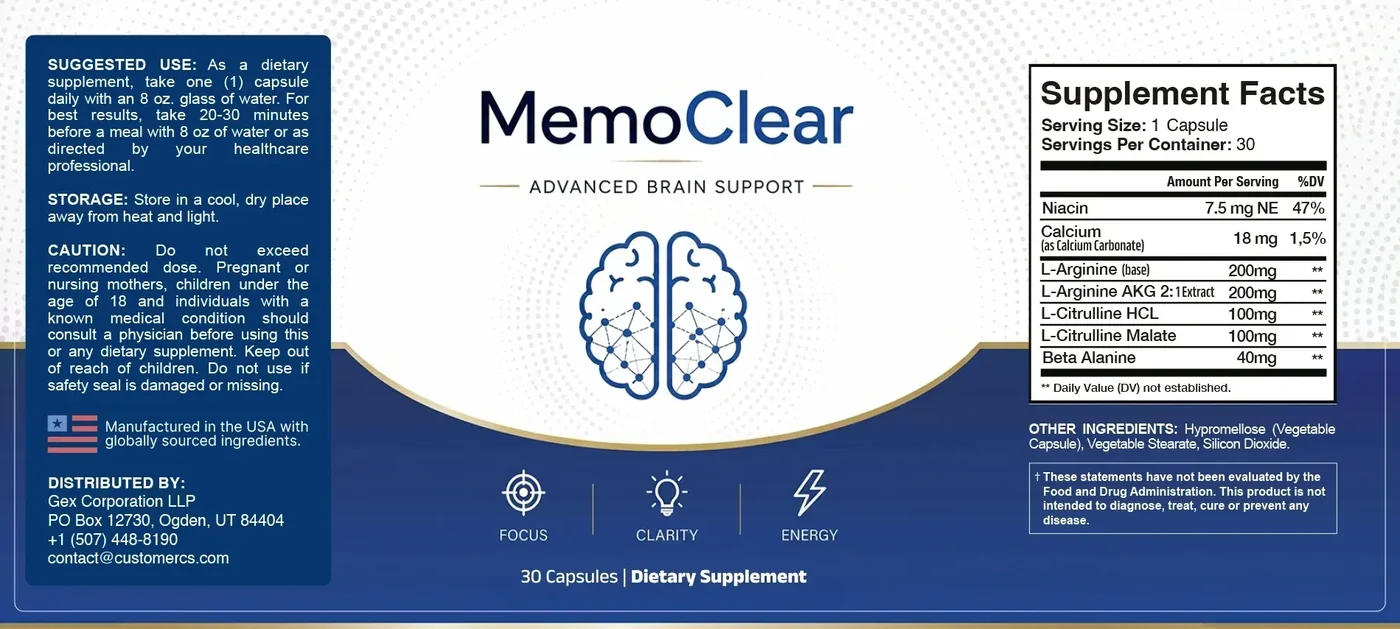
- Verify: a published panel you can check yourself — the way Memoclear lists every amount.

Search "best brain supplements" and you get roughly 6,600 results a month competing for your attention, most of them ranked by advertising budget rather than evidence. This guide does the opposite. It starts from the ingredients that have actually been tested in people, translates the research into a checklist you can carry into any store, and then shows where a broad, transparent formula like Memoclear fits. No hype, no cure claims, just the questions that separate a serious brain supplement from expensive powder in a nice bottle.
The five questions the best brain supplements can all answer
Before you compare brands, compare against a standard. A formula worth your money can survive these five questions without flinching. Most cannot.
1. Are the ingredients named, and are they dosed at trial levels? "Contains bacopa" tells you nothing. The randomised trials on bacopa monnieri used roughly 300 mg a day of a standardised extract over eight to twelve weeks. A capsule that lists bacopa but delivers 30 mg is technically honest and functionally decorative. The same gap between "present" and "studied dose" applies to citicoline (studied around 250–500 mg), phosphatidylserine (100–300 mg) and omega-3 DHA (several hundred milligrams). The label either meets the research or it does not.
2. Is there a proprietary blend hiding the amounts? A proprietary blend discloses the combined weight of several ingredients but not the split between them. That lets a brand headline an impressive-sounding component that might be present in a pinch. If the panel groups five ingredients into one number, you cannot verify a single dose, and you should treat the whole blend as unproven until told otherwise.
3. Does the marketing avoid disease claims? This is a quality signal disguised as a legal one. A supplement is allowed to say it "supports memory" or "supports focus". It is not allowed to say it treats, prevents or reverses a disease, because no supplement has been shown to do that. Brands that reach for cure language are telling you they will say whatever sells, which is exactly the mindset that produces trace doses behind big promises.
4. Can you find the actual Supplement Facts panel before you buy? If a brand is proud of its formula, the panel is easy to find. If you have to add to cart and wait for the bottle to see what is inside, that is a decision, not an oversight.
5. Is the price justified by milligrams, not marketing? We will come back to this, because "expensive equals effective" is the single most costly myth in the category.
The ingredients worth paying for — and the doses that matter
You do not need a fifteen-ingredient formula. You need a handful of components that have cleared human trials, present in amounts you can actually take. Here is the shortlist the best brain supplements tend to draw from.
Bacopa monnieri. The strongest of the herbal candidates for memory. Multiple small randomised trials, usually running eight to twelve weeks, have reported improvements in delayed recall. It is not a same-day ingredient; it needs consistent daily use. Mild stomach upset is the most common complaint, which is why it is best taken with food.
Citicoline. A choline source with small trials pointing at attention and processing speed. Much of the research is funded by ingredient suppliers, which does not make it wrong but does mean you should read it with that in mind. Studied amounts sit in the few-hundred-milligram range.
Phosphatidylserine. A phospholipid that is a genuine structural component of brain cell membranes. It has a reasonable evidence base for supporting memory in older adults, typically at 100 to 300 mg a day. It is one of the better-supported entries on most premium labels.
Omega-3 DHA. The one nearly everyone under-consumes. DHA is a building block of neural tissue, and while fish-oil trials for cognition are mixed, the case for correcting a low intake is solid. If your diet is short on oily fish, this is a rational baseline before any exotic nootropic.
Lion's mane. Popular and genuinely interesting, but honest framing matters. The compelling work on nerve growth factor is largely in cell cultures and rodents; the human trials are few, small and short. Worth curiosity, not certainty.
Huperzine A. A potent compound that should raise your caution, not just your interest. It is pharmacologically active, and "natural" does not mean "gentle" or "take indefinitely without advice". Its presence on a label is a reason to read the dose carefully and talk to a clinician, especially if you take medication.
If you want the same distinctions drawn trial by trial, our companion piece on what brain booster supplement labels really mean walks through how these amounts get disguised in practice.
Want a formula that shows its work?
Memoclear is a stimulant-free daily capsule built around blood-flow amino acids and B-vitamin support, with the entire Supplement Facts panel published so you can run every check in this guide before you decide. No proprietary blend, no cure claims.
Check Availability & OptionsMyth one: the priciest brain supplement is the best one
Price is a marketing variable, not a measure of active ingredient. Two products can carry identical panels and a thirty-dollar gap, and two products at the same price can differ tenfold in the amount of studied ingredient per serving. Premium packaging, celebrity endorsement and a heavy ad spend all cost money that arrives in the price and never reaches your capsule.
The honest way to compare is cost per day at the effective serving size. Divide the price by the number of days the bottle lasts when taken as directed, then ask what you are getting for that daily figure in milligrams of things that have been tested. A cheaper product with disclosed, trial-level doses beats an expensive proprietary blend every time. The label, not the receipt, is where value lives.
Myth two: a longer ingredient list means a stronger formula
It is intuitive that more ingredients should mean more benefit. In practice the opposite often holds. Only so much powder fits in a capsule, so a formula boasting eighteen ingredients has usually cut each one to a fraction of its studied dose to make room. The label looks generous and performs like a placebo. A focused formula with four or five components at real amounts will typically out-deliver a "kitchen sink" blend that is impressive to read and impossible to feel. When you are scanning for the best brain supplements, count the doses that clear the research bar, not the number of lines on the panel.
Myth three: if it is sold widely, it must be proven
Distribution is a business achievement, not a scientific one. The clearest cautionary tale is a household brand: in December 2024, after a jury trial, a court ordered the makers of Prevagen to stop claiming the supplement improves memory, in a case brought by the Federal Trade Commission and the New York Attorney General. The jury found the company had not substantiated those claims with reliable scientific evidence. A best-selling product sold in every pharmacy still had its central claim rejected in court, which tells you how little shelf space proves. (A separate brand, Neuriva, settled a consumer class action over its own brain-performance advertising for $8 million — a different case, and not an FTC one.) We untangle that story, and what FDA approval does and does not mean in this aisle, in is Neuriva FDA approved and who makes it.
The flip side is worth stating fairly. Alpha Brain is the rare finished product that funded a published randomised controlled trial and reported gains on a verbal memory measure at six weeks. That is genuinely more than most of its competitors can show, and it belongs in an honest guide. It also underlines the point: evidence comes from testing the actual product, not from the fame of the label. We compare that trial and its limits in our piece on nootropics backed by replicated trial evidence.
The 2026 brain supplement scorecard
| What to check | Green flag | Red flag |
|---|---|---|
| Dosing | Amounts match published human trials | Fairy-dust doses far below research |
| Transparency | Full panel, every ingredient itemised | Proprietary blend hides the split |
| Claims | "Supports" memory and focus | Treats, prevents or reverses disease |
| Value | Judged on cost per day and milligrams | Premium price as proof of quality |
| Access | Label visible before purchase | Formula only revealed after you buy |
| Stimulants | Disclosed, or clearly stimulant-free | Hidden caffeine driving the "effect" |
The best brain supplement is not the one with the boldest claim or the highest price. It is the one whose label you can read, verify against the research, and hand to a pharmacist without flinching.
Where Memoclear fits the checklist
Memoclear was built to answer the five questions above rather than dodge them. It is a once-daily, stimulant-free capsule organised around blood-flow amino acids and B-vitamin support, and the complete Supplement Facts panel is published on the site so nothing hides behind a blend. That design reflects a deliberate position: rather than lead with a two-ingredient headline, it leans on nutrients tied to circulation and normal neurotransmission, and it says plainly what the evidence does and does not show.
It is not marketed as a cure, because nothing in this category is one. What it offers is the thing this guide keeps returning to — a formula you can audit. If you have read this far, you already know how to evaluate it: check the amounts, compare the cost per day, and see whether the claims stay on the right side of the line. You can read the full ingredient rationale in our breakdown of the evidence behind Memoclear's formula and decide for yourself.

What even the best brain supplements cannot do
Set the ceiling honestly. The ingredients that hold up in trials produce effects that are modest, measurable under test conditions, and easily swamped by the rest of your life. None of them beats a full night of sleep. None outperforms regular aerobic exercise for long-term brain health. None fixes an untreated thyroid problem, an iron deficiency, unmanaged blood pressure, or the fog that comes with chronic stress or low mood.
Results vary because you do. Baseline nutrient status, diet, genetics and sleep debt all shape whether a well-supported ingredient does anything you can notice. And because supplements are regulated as food rather than medicine, "widely sold" and "clinically proven" are not the same sentence. If your memory or thinking has changed noticeably over weeks or months, that is a medical situation and a clinician is the right first call, not a shopping decision.
Medical note: this article is general information, not medical advice. Speak to a healthcare professional before starting any supplement, especially if you are pregnant, nursing, or taking medication — several nootropic ingredients, including huperzine A, are pharmacologically active or affect blood flow.
Frequently asked questions
What should I look for in the best brain supplement?
Look for named ingredients at the amounts used in human trials, not just a familiar word on the front of the box. The most studied are Bacopa monnieri, citicoline, phosphatidylserine, omega-3 DHA and, at the herbal end, lion's mane and huperzine A. A transparent Supplement Facts panel with no proprietary blend, a clear serving size, and no disease-cure language are the marks of a serious formula.
Are expensive brain supplements worth the money?
Not automatically. Price often reflects branding, packaging and marketing rather than milligrams of active ingredient. A cheap product can hide a trace-dose proprietary blend and an expensive one can too. Judge value by the amount of studied ingredient per serving and the cost per day, not by the sticker price or the size of the claims.
Do brain supplements actually improve memory and focus?
Some ingredients show modest, measurable benefits in randomised trials, particularly for attention and aspects of memory, but the effects are smaller than advertising suggests and vary a lot between people. Supplements support normal cognitive function; they do not cure disease. Sleep, exercise and correcting a genuine nutrient shortfall usually move the needle more than any capsule.
How is Memoclear different from other brain supplements?
Memoclear is a stimulant-free daily capsule that publishes its full Supplement Facts panel so you can check the amounts against the research yourself. It is built around blood-flow amino acids and B-vitamin support rather than a two-ingredient headline, and the site cites its sources and flags weak evidence instead of promising a cure.
Related reading
Scientific references
- Federal Trade Commission — Statement on the FTC’s win in the lawsuit against the makers of the dietary supplement Prevagen (December 2024)
- NIH NCCIH — Dietary supplements and cognitive function, dementia, and Alzheimer’s disease: what the science says
- Kongkeaw C. et al. — Meta-analysis of randomized controlled trials on cognitive effects of Bacopa monnieri extract (Journal of Ethnopharmacology, 2014)
- National Institute on Aging — Cognitive health and older adults, including supplements and brain health
- Harvard Health Publishing — Foods linked to better brainpower
Ready to compare Memoclear against your checklist?
A stimulant-free daily capsule with the full panel published, so you can verify every dose in this guide before you commit. If you have been searching for the best brain supplements without wading through hype, start with the label.
Want the format debate first? Read all-in-one nootropics versus single-ingredient dosing, or start with the full Memoclear ingredient and label guide.