Is Neuriva FDA approved, and who actually makes it?
Quick answer: is Neuriva FDA approved, and who makes it?
No, Neuriva is not FDA approved, because no dietary supplement is. The FDA does not review or approve supplements for safety or effectiveness before they go on sale. Neuriva is made by Reckitt, the British consumer-health company behind Lysol, Mucinex and Airborne, and is sold in the United States under its Schiff Nutrition arm. No published clinical trial has tested the finished Neuriva product; the research belongs to its two ingredients.
- FDA status: not approved, and not approvable — supplements skip pre-market approval by law.
- Maker: Reckitt, via Schiff Nutrition, US launch in 2018.
- Tested? the ingredients have studies; the finished product does not.
Two questions dominate Neuriva searches, and the product's own marketing answers neither clearly: is it FDA approved, and who is behind it. Both have short, checkable answers. This guide gives them plainly, then explains why they matter less than the question almost nobody asks.
Is Neuriva FDA approved? No, and no brain supplement is
Neuriva is not FDA approved, and it cannot be, because dietary supplements are not eligible for FDA approval in the first place. Under the Dietary Supplement Health and Education Act of 1994, supplements are regulated as a category of food rather than as drugs. A company may formulate a product, manufacture it and put it on a shelf without the FDA reviewing whether it is safe or whether it works. As the FDA states in its own consumer guidance on dietary supplements, the agency is not authorised to approve them before they are marketed, and the manufacturer carries the responsibility for making sure its product is safe and its labelling is truthful.
What the FDA can do is act after the fact: inspect manufacturing sites, issue warning letters, seize adulterated products and push for recalls once a supplement is on sale. That is a real safety net, but a reactive one, and not a seal of approval. It is why every supplement label in the United States, Neuriva's included, carries the same sentence — these statements have not been evaluated by the Food and Drug Administration, and this product is not intended to diagnose, treat, cure or prevent any disease.
So "is it FDA approved" is the wrong test for a brain supplement, because the honest answer for every product in the category is no. The useful questions are what is in it, at what dose, and whether anyone has tested the thing in the bottle, which our guide to what brain booster supplement labels actually mean shows you how to read off the pack.
What "FDA registered" and "made in an FDA-registered facility" really mean
An FDA-registered facility is one that has filed its details with the FDA, as the law requires of any supplement manufacturer. Registration is an administrative obligation, not an inspection result and not an endorsement, and the FDA is explicit that it does not mean the agency has approved the products made there. The phrase appears on packaging so often precisely because it sounds like approval while promising nothing.
The same applies to the other reassuring phrases here. "GMP certified" refers to Good Manufacturing Practice, process standards covering whether the right ingredient goes into the right bottle at the stated amount, uncontaminated. That is worth having, because supplement quality problems are real, but it describes manufacturing consistency, not efficacy. A capsule can be flawlessly made and still do nothing for your memory.
Read the two phrases together and the pattern is clear: they answer questions about process, never about outcome. Neither one is a lie, and neither one is evidence.
Who makes Neuriva? Reckitt, through Schiff Nutrition
Neuriva is made by Reckitt, the British consumer-health and household-products company whose other brands include Lysol, Mucinex, Durex and Airborne. Reckitt lists Neuriva among its own US brands and says it introduced the product to the American market in 2018. The supplement itself is sold under Schiff Nutrition, a Salt Lake City vitamin business that Reckitt acquired in 2012 and now operates as part of its health portfolio, which is why bottles and retail listings sometimes carry the Schiff name alongside Neuriva's.
So Neuriva is not a white-label product from an anonymous seller. It comes from a large, publicly listed multinational with an established consumer-health division and a reputation to protect. That is worth knowing, and worth not over-reading.
Why a big-name manufacturer is reassuring, and where the reassurance stops
A major manufacturer genuinely reduces certain risks: more formal quality systems, more scrutiny of what goes into the bottle, and far more to lose from a contamination incident. If your worry is whether the capsule contains what the label says, a Reckitt-owned brand is a lower-risk bet than an unknown marketplace seller.
But corporate scale is not scientific evidence. A company's size tells you about its supply chain, not about whether its formula changes anything in your head, and some of the most heavily marketed supplements in the category come from the largest companies. The rest of this article is about that distinction.
Has Neuriva itself been tested? What "clinically tested" means here
There is no published randomised controlled trial of the finished Neuriva product in the peer-reviewed literature. That is the single most important fact on this page, and it is easy to miss because the marketing language sits so close to it. When a label says its ingredients are clinically tested, it is making a claim about the ingredients, not about the product. Those are different things, and the gap between them is where most of the disappointment in this category lives.
Why does that matter? Because dose and combination change outcomes. An ingredient studied at 300 mg may appear in a commercial capsule at a fraction of that, and ingredients dilute or compete with one another when several are crammed into one pill. A study of a single compound in isolation, at a dose the product does not contain, cannot tell you what the product does. We lay out which nootropics clear the higher bar of independent, repeated testing in our review of nootropics with genuinely replicated trial evidence — a much shorter list than the aisle suggests.
What Neuriva's two ingredients actually have behind them
Neuriva is built on two actives: a coffee-cherry extract branded Neurofactor, made from the fruit around the coffee bean rather than the bean, and phosphatidylserine, a phospholipid that is a genuine component of brain-cell membranes. Some versions add B vitamins. Here is the honest state of the evidence.
| Ingredient | What the marketing leans on | What the evidence actually supports |
|---|---|---|
| Coffee-cherry extract (Neurofactor) | Raising BDNF, a protein involved in neuron health and growth | Small, mostly manufacturer-linked studies of a blood marker. A change in a blood protein is not a change in your memory. |
| Phosphatidylserine | Membrane support and memory in older adults | A real but mixed record. Early positive results used a bovine-derived form no longer sold; a randomised trial of the soy-derived form now used did not reproduce them. |
| B vitamins (some versions) | Brain and nervous-system support | Correcting a genuine deficiency helps. Adding more on top of an adequate intake generally does not. |
| The finished product | Fuels indicators of brain performance | No published trial of the finished formula. |
The phosphatidylserine story deserves an extra sentence, because it is the strongest ingredient here and still not simple. Most of the encouraging older research used a form derived from bovine brain cortex, which was withdrawn over safety concerns. When researchers tested the soy-derived form that replaced it, a randomised trial in adults with age-associated memory impairment found no significant benefit on the memory measures the bovine studies had moved. That does not make it worthless, but the confident version of the claim outruns the data.
Has Neuriva been sued, and was it the FTC?
Neuriva has faced a legal challenge over its advertising, but not from the FTC — the detail most articles get wrong. Reckitt was sued in a consumer class action, Williams v. Reckitt Benckiser, over marketing describing Neuriva's ingredients as clinically proven to fuel five indicators of brain performance: memory, focus, accuracy, learning and concentration. The plaintiffs argued the supporting research was on individual ingredients rather than the product. Reckitt settled for $8 million and agreed to advertising changes, without admitting wrongdoing. A settlement is not a ruling that a product does not work; it is a company choosing not to fight.
The case people merge with it is a different brand. In December 2024, after a jury trial, a court ordered the makers of Prevagen to stop claiming the supplement improves memory in an action brought by the Federal Trade Commission and the New York Attorney General, the jury having found the claims unsubstantiated. That is a genuine jury verdict against a memory supplement — it simply is not Neuriva's.
Medical note: this article is general information, not medical advice. No dietary supplement diagnoses, treats, cures or prevents disease. If your memory or thinking has changed noticeably, speak to a clinician rather than reaching for a supplement, and check with a healthcare professional before starting anything new if you are pregnant, nursing or taking medication.
How to check any brain supplement's regulatory claims in five minutes
You can settle most of these questions yourself. The checks below apply to any product in this aisle, Neuriva and Memoclear included.
- Assume it is not FDA approved. No supplement is. If a page implies otherwise, that alone tells you how carefully the rest of it was written.
- Separate process claims from outcome claims. FDA registered, GMP certified and made in the USA describe how and where something was manufactured. None of them is evidence that it works.
- Find the Supplement Facts panel, not the marketing page. Look for each active ingredient with its own milligram amount. A proprietary blend that prints only a combined weight has withheld the number you need.
- Search the finished product by name in PubMed. If nothing comes back, it has not been tested as sold, whatever the packaging implies.
- Compare the dose to the studies. Take one headline ingredient, find the amount used in human trials, and check the label reaches it — a step that disqualifies a surprising share of the shelf, as our 2026 buyer's guide to brain supplements works through.
It also means knowing who should be cautious: some cognitive-support ingredients affect blood flow or interact with medication, which we cover in our guide to memory supplement side effects and who should avoid them.
What this means if you already take Neuriva
Nothing here says Neuriva is dangerous or fraudulent. It is a legitimately manufactured product from a major company, its two ingredients are real compounds with real literature behind them, and the absence of FDA approval is a fact about the whole category rather than a mark against this brand. If you take it and feel it helps, the evidence does not require you to stop.
What it does justify is calibrating expectations. You are buying two ingredients, one with a mixed record in the form actually used, in a product never tested as a finished formula, from a company that settled rather than defended the clinically-proven claim. That may still be a reasonable purchase — it is just a different purchase from the one the packaging describes. If you are weighing it against a fuller, disclosed-dose formula, our closer look at how Neuriva works and what the alternatives are puts the two side by side, and our guide to where to buy Memoclear and what the guarantee covers explains what to check before ordering in this category.
Frequently asked questions
Is Neuriva FDA approved?
No. Neuriva is a dietary supplement, and the FDA does not approve dietary supplements before they are sold. Under the Dietary Supplement Health and Education Act of 1994 a company may market a supplement without pre-market approval of its safety or effectiveness, and the FDA generally acts only once a product is on sale. No brain supplement of any kind is FDA approved.
Who makes Neuriva?
Neuriva is made by Reckitt, the British consumer-health company behind brands such as Lysol, Mucinex and Airborne. It is sold in the United States through Schiff Nutrition, the Salt Lake City vitamin business Reckitt bought in 2012, and Reckitt lists Neuriva among its own brands. Reckitt introduced Neuriva to the US market in 2018.
Does an FDA-registered facility mean Neuriva is FDA approved?
No, and the two are easy to confuse. Facilities making dietary supplements are required to register with the FDA, so registration is a legal obligation rather than a mark of quality, and it does not mean the agency has approved or endorsed the product. A label leaning on the phrase FDA registered is describing paperwork, not a verdict on whether the supplement works.
Has Neuriva itself been tested in a clinical trial?
There is no published randomised controlled trial of the finished Neuriva product. The research the marketing points to was done on its individual ingredients, coffee-cherry extract and phosphatidylserine, and that gap is exactly what a consumer class action targeted before Reckitt settled it for $8 million without admitting wrongdoing.
Related reading
Scientific references
- U.S. Food and Drug Administration — Questions and answers on dietary supplements (pre-market approval, manufacturer responsibility)
- U.S. Food and Drug Administration — Dietary supplements: regulation, facility registration and post-market enforcement
- Federal Trade Commission — Statement on the FTC’s win in the lawsuit against the makers of the dietary supplement Prevagen (December 2024)
- Jorissen B.L. et al. — The influence of soy-derived phosphatidylserine on cognition in age-associated memory impairment (Nutritional Neuroscience, 2001)
- NIH Office of Dietary Supplements — Dietary supplements: what you need to know
- NIH NCCIH — Dietary supplements and cognitive function, dementia, and Alzheimer’s disease: what the science says
- Reckitt — Neuriva brand page (US), manufacturer and market-launch details
Want a formula that prints every amount?
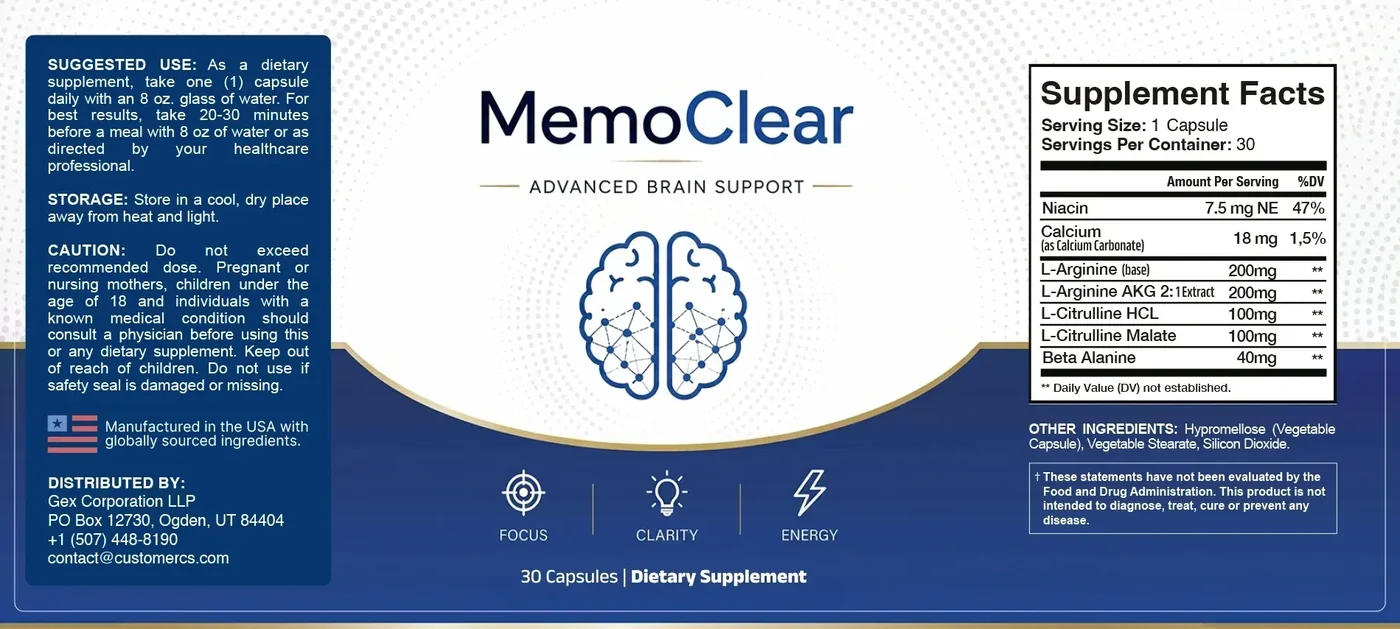
Memoclear is a stimulant-free daily capsule with its complete Supplement Facts panel published, so you can check each ingredient against the research yourself instead of taking a claim on trust. It is not FDA approved either — nothing in this aisle is — and it does not pretend to be.
Check Availability & Options