Neuriva 2026: Does It Really Work, and What Is a Better Alternative?
Quick answer: does Neuriva really work?
Neuriva is a two-ingredient brain supplement built on coffee-cherry extract and phosphatidylserine. Both ingredients have some research, but that research is on the ingredients rather than the finished product — a gap that drew a consumer class action Reckitt settled for $8 million. Any real-world benefit is likely modest and varies by person, and it is not a treatment for memory loss or disease.
- Formula: coffee-cherry (Neurofactor) plus phosphatidylserine, sometimes B-vitamins.
- Legal note: an $8m class-action settlement over its brain-performance claims — not an FTC case.
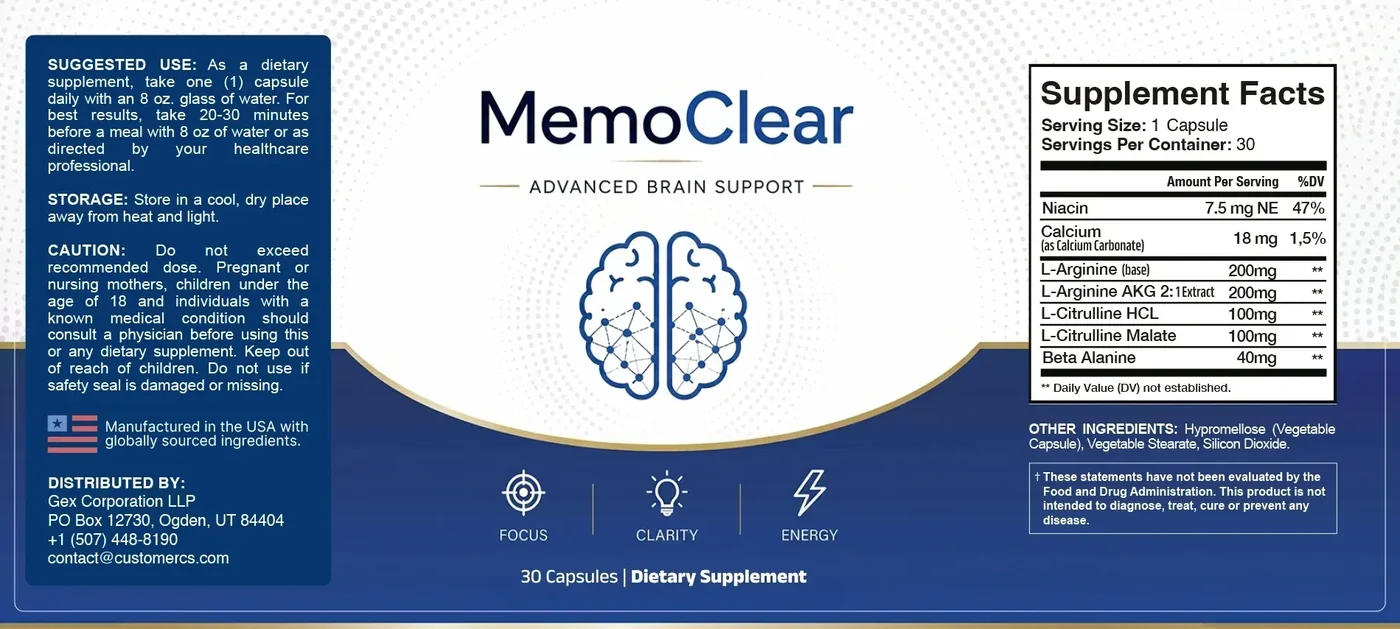
- Alternative: a broader, transparently dosed formula such as Memoclear.
If you have seen Neuriva on a pharmacy shelf or in a television ad, you have met one of the most recognisable brain supplements in the United States, pulling tens of thousands of searches a month. This Neuriva review is deliberately balanced: it credits what the product does reasonably, explains the regulatory trouble it ran into, and then sets it against what a fuller, more transparent formula looks like. The goal is not to dunk on a competitor but to help you judge whether a two-ingredient base is what you actually want to pay for.
What is in Neuriva, and what each ingredient does
Neuriva's identity rests on two components, which is unusually lean for the category. The first is a coffee-cherry extract sold under the branded name Neurofactor, derived from the fruit that surrounds the coffee bean rather than the bean itself. The marketing case for it centres on a compound called BDNF — brain-derived neurotrophic factor, a protein involved in the health and growth of neurons — with the suggestion that the extract can raise it. The second is phosphatidylserine, a phospholipid that is a genuine structural component of brain cell membranes and one of the better-supported single ingredients for memory support in older adults. Some versions of the line add B-vitamins such as B6, B12 and folate.
On paper, neither ingredient is a gimmick. Phosphatidylserine in particular has a reasonable body of research behind it at studied doses. The question a good review has to ask is not "are these ingredients real?" but two harder ones: are they present at the amounts used in the supporting studies, and does the finished product deliver on what its advertising promises? That second question is where Neuriva's story takes a turn. If the question you arrived with was the regulatory one instead, we answer it separately in is Neuriva FDA approved, and who actually makes it.
Has Neuriva been sued over its memory claims? What actually happened
You cannot fairly assess Neuriva without addressing its advertising history, because it goes to the heart of the "does it work" question — but it is worth getting the facts right, because this is one of the most garbled stories in the category. Neuriva was not the subject of a Federal Trade Commission jury trial. What happened is that Neuriva's owner, Reckitt Benckiser, was sued in a consumer class action (Williams v. Reckitt Benckiser) over marketing that described the product as containing clinically proven ingredients that fuel five indicators of brain performance — memory, focus, accuracy, learning and concentration. The plaintiffs argued the supporting research was on individual ingredients rather than the finished product. Reckitt settled for $8 million, with changes to how the product is advertised, and did not admit wrongdoing. A settlement is not a court finding that the product does not work; it is a company deciding not to litigate the claim.
The case people usually have in mind is a different brand. In December 2024 the FTC and the New York Attorney General won their long-running case against Quincy Bioscience over Prevagen, where a jury found the company had not substantiated its memory claims and the court ordered it to stop making them. That is a genuine jury verdict against a memory supplement — it is simply not Neuriva's. We keep the two apart here because conflating them is exactly the kind of sloppy sourcing this site exists to avoid.
It is important to be precise about what that does and does not mean. It does not mean the ingredients are dangerous or fraudulent, and it does not mean phosphatidylserine has no evidence of its own. What it means is that the leap from "contains studied ingredients" to "clinically proven to improve your memory" is the leap that drew the legal challenge, and the one Reckitt chose to settle rather than defend. That is exactly the gap this site keeps flagging across the whole category: an ingredient having literature behind it is not the same as a specific product, at its specific doses, having been shown to work. We walk through that distinction in detail in our guide to nootropics backed by replicated trial evidence, and Neuriva is close to a textbook illustration of it.

So does Neuriva work? An honest verdict
Here is the balanced answer. For some people, a phosphatidylserine-based supplement taken consistently may offer modest support for everyday memory, and the coffee-cherry component is not implausible as a contributor. If you already own a bottle, it is not a scandal to finish it. But the strong version of the claim — that Neuriva reliably improves your memory and focus in a way you will notice — is precisely the version that has never been demonstrated for the finished product, and the version that drew the lawsuit. Any effect is likely to be small, slow to appear, and easily swamped by sleep, stress and diet.
The bigger structural criticism is not about the two ingredients at all; it is about how few of them there are. A two-ingredient base leaves a lot of well-supported territory untouched. It does nothing for blood flow, the circulatory side of cognition that blood-flow amino acids target. It leans heavily on a single memory mechanism. And because the formula is short, the marketing has to work hard to make it feel comprehensive, which is arguably how the claims drifted ahead of the evidence in the first place. This is the trade-off we examine in our 2026 buyer's guide to the best brain supplements: a lean formula is easy to understand and easy to under-deliver.
Want a fuller formula that publishes every dose?
Memoclear is a stimulant-free daily capsule built around blood-flow amino acids and B-vitamin support, with the complete Supplement Facts panel published so you can check the amounts yourself — the transparency a two-ingredient base makes easy and a court case makes essential.
Check Availability & OptionsNeuriva versus a broader, transparent formula
The most useful thing a Neuriva review can do is show you the alternative shape of a brain supplement, so you can decide which trade-off suits you. On one side sits the lean, heavily branded, two-ingredient approach. On the other sits a broader formula that spreads across more than one mechanism — circulation, neurotransmitter support and B-vitamin cofactors — and, critically, prints every amount so nothing hides.
That is the position Memoclear is built for. It is a once-daily, stimulant-free capsule organised around blood-flow amino acids with B-vitamin support, and its full panel is published on the site. The point is not that it is a magic upgrade; it is that it answers the two questions Neuriva's story raised. You can see the doses, and the marketing stays on the honest side of the line by describing support for normal function rather than promising a cure. If you want the ingredient-by-ingredient reasoning, our breakdown of the evidence behind Memoclear's formula lays it out with the same scepticism we applied to Neuriva here.
Neuriva vs a broader formula at a glance
| Factor | Neuriva (core) | Broader transparent formula |
|---|---|---|
| Number of active ingredients | Two headline ingredients | Multiple, across several mechanisms |
| Mechanisms covered | Membrane support; BDNF claim | Blood flow, neurotransmitters, B-vitamins |
| Dose transparency | Limited on the front of pack | Full Supplement Facts panel published |
| Claims posture | Brain-performance claims settled in class action | "Supports" normal function, no cure claims |
| Stimulants | Coffee-derived, low | Stimulant-free by design |
The lesson of the Neuriva case is not "avoid these ingredients". It is "read the label, not the promise". A product is only as good as the doses you can verify and the claims it is willing to stand behind.
Common objections, answered honestly
"But Neuriva is sold everywhere — surely that means it works?" Wide distribution is a business achievement, not a scientific one. Neuriva is the clearest example on the shelf: a best-seller in every pharmacy whose central brain-performance claim was still challenged in court and settled rather than defended. Availability tells you about marketing reach, not efficacy.
"Aren't all brain supplements the same anyway?" No. They differ enormously in how many ingredients they carry, whether those ingredients are dosed at studied levels, and whether the amounts are disclosed at all. A two-ingredient product and a broader transparent one are genuinely different purchases, even if both sit in the same aisle.
"If the ingredients have studies, isn't the criticism unfair?" The criticism is not of the ingredients; it is of the claim. Phosphatidylserine has real research. The problem was the finished product being advertised as clinically proven to improve memory when no trial of the finished product had established that. Phosphatidylserine's own record is mixed: a randomised trial of soy-derived phosphatidylserine in age-associated memory impairment did not reproduce the memory benefits reported for the older bovine-derived form. Holding a product to its own advertising is not unfair — it is the whole point of a review.
What no brain supplement, Neuriva included, can do
Set the ceiling honestly, because it applies to every product in this article. No dietary supplement — Neuriva, Memoclear or anything else — has been shown to prevent, treat, cure or reverse a disease, and that includes memory loss, dementia and cognitive decline. Supplements are sold to support normal function, and the honest ceiling for even the best-supported ingredients is "modest, measurable under test conditions, and easily outweighed by sleep, exercise and diet".
Results vary because people vary. Baseline nutrient status, age, diet and sleep debt all shape whether you notice anything at all. And if your memory or thinking has changed noticeably over weeks or months, that is a medical situation that deserves a clinician's attention, not a shopping decision. A brain supplement, at its best, is a small supporting player in a much larger picture.
Medical note: this article is general information and an independent review, not medical advice. Speak to a healthcare professional before starting any supplement, especially if you are pregnant, nursing, or taking medication.
Frequently asked questions
Does Neuriva actually improve memory?
The evidence is thin. Neuriva's two headline ingredients, coffee-cherry extract and phosphatidylserine, each have some supporting studies, but no published trial has tested the finished Neuriva product itself, which is the gap a consumer class action targeted before Reckitt settled it for $8 million. Any benefit is likely to be modest and varies between people; it is not a treatment for memory loss or any disease.
Has Neuriva been sued over its brain-health claims?
Yes, but not by the FTC. Neuriva's owner Reckitt Benckiser was sued in a consumer class action, Williams v. Reckitt Benckiser, over advertising that called its ingredients clinically proven to fuel five indicators of brain performance. Reckitt settled for $8 million without admitting wrongdoing. The 2024 FTC jury case people often confuse it with was against Quincy Bioscience over Prevagen, a different product.
What are the main ingredients in Neuriva?
Neuriva's core formula is built on two ingredients: a coffee-cherry extract branded Neurofactor, and phosphatidylserine, a phospholipid found in brain cell membranes. Some versions add vitamins such as B6, B12 and folate. It is a deliberately short formula compared with broader multi-ingredient brain supplements.
What is a good alternative to Neuriva?
A good alternative is a fuller formula that is transparent about its doses and honest about its claims. Rather than a two-ingredient base, look for a stack that covers blood flow and B-vitamin support with the full panel published, such as Memoclear, so you can verify the amounts yourself and avoid paying for marketing rather than milligrams.
Related reading
Scientific references
- Federal Trade Commission — Statement on the FTC’s win in the lawsuit against the makers of the dietary supplement Prevagen (December 2024)
- Jorissen B.L. et al. — The influence of soy-derived phosphatidylserine on cognition in age-associated memory impairment (Nutritional Neuroscience, 2001)
- NIH NCCIH — Dietary supplements and cognitive function, dementia, and Alzheimer’s disease: what the science says
- National Institute on Aging — Cognitive health and older adults, including supplements and brain health
- Harvard Health Publishing — Foods linked to better brainpower
Looking for a fuller-formula alternative to Neuriva?
A stimulant-free daily capsule that spreads across blood flow and B-vitamin support, with every amount published so you can verify the doses and skip the guesswork. Compare it against your own checklist before you decide.
Prefer the ingredient breakdown first? Read the full Memoclear ingredient and label guide, or compare formats in all-in-one nootropics versus single-ingredient dosing.