Alpha Brain vs Memoclear Compared: Evidence, Doses and Price
Quick answer: Alpha Brain vs Memoclear, which should you pick?
Alpha Brain has the stronger published evidence — a randomized, double-blind, placebo-controlled trial on the finished product showed verbal-memory and processing-speed gains at six weeks. Memoclear leads on transparency, disclosing every ingredient amount rather than hiding it inside a proprietary blend. Choose verified evidence, or choose a readable label you can check.
- Alpha Brain wins on: a published finished-product trial and long market track record.
- Memoclear wins on: disclosed per-ingredient doses and no proprietary blend.
- The tell: both are caffeine-free, so compare labels and price per serving, not "kick".

Search "Alpha Brain" and you land in one of the most crowded corners of the supplement aisle, and almost every result is trying to sell you something. This one is trying to do something less common: put Alpha Brain and Memoclear side by side and be honest about where each one genuinely leads. Alpha Brain, from Onnit, is a rare thing in this category because it has actually been tested as a finished product in a controlled trial. Memoclear takes the opposite bet, competing on a label that hides nothing. Neither approach is a scam and neither is a miracle, so the useful question is which trade-off fits how you think.
By the end you will know exactly where Alpha Brain has the edge, where a disclosed-dose formula like Memoclear pulls ahead, and how to read either label without being spun by the marketing. No hype, no "this one weird capsule", and no pretending a supplement can do a doctor's job.
Where Alpha Brain genuinely leads: published trial evidence
Let us hand Alpha Brain its strongest card first, because it is a real one. Most nootropics you can buy have never been tested as a finished product. Their marketing borrows studies about individual ingredients — often at doses the capsule does not contain — and hopes you will not check. Alpha Brain is one of the few exceptions. A 2016 randomised, double-blind, placebo-controlled trial in Human Psychopharmacology tested the actual commercial formula, not just its parts, in 63 adults aged 18–35, and after six weeks reported significant improvement on tasks of delayed verbal recall and executive functioning compared with placebo.
That is a meaningfully higher bar than most competitors clear, and it deserves respect. Testing the finished product controls for the interactions and the real-world dosing that ingredient-by-ingredient claims quietly ignore. If your single most important criterion is "has anyone actually studied the thing in the bottle", Alpha Brain wins that contest against most of the shelf, Memoclear included.
Honesty cuts both ways, though. It was a single trial, an author was employed by the manufacturer, the sample was 63 people, and the paper's own authors called for further study. Independent replication — a second, unaffiliated team finding the same thing — is what turns a promising result into a settled one, and that replication is thin here. So the fair summary is: Alpha Brain has better evidence than nearly everything it competes with, and that evidence is still early rather than conclusive. Both statements are true at once. We dig into what separates a one-off study from a durable finding in our breakdown of which nootropics have genuinely replicated trial evidence.
Proprietary blends versus disclosed doses
Here is where the comparison flips, and where a lot of buyers get quietly short-changed across the whole category. Alpha Brain organises its ingredients into named proprietary blends — a flow blend, a focus blend, a fuel blend. The label tells you the combined weight of each blend, but not how many milligrams of each individual ingredient are inside it.
That matters more than it sounds. Blend ingredients are listed in descending order by weight, so the first-named ingredient could be most of the blend and the ingredient you actually came for could be a sliver at the end. You cannot tell. You cannot line any single ingredient up against the amount used in research, because the amount is not printed. A proprietary blend is not automatically dishonest — some brands use them to protect a genuinely novel recipe — but it does take away your ability to verify a single dose claim.
Memoclear takes the opposite position: no proprietary blend, every ingredient printed with its own milligram amount. You can sit with the panel, a search engine and ten minutes, and check each ingredient against published human studies yourself. That will not make a mediocre ingredient work, but it hands you the one thing a blend withholds — the ability to audit the product instead of trusting the front of the box. If you want the vocabulary to do this well, our guide to what brain booster supplement labels actually mean walks through the exact phrases to distrust.
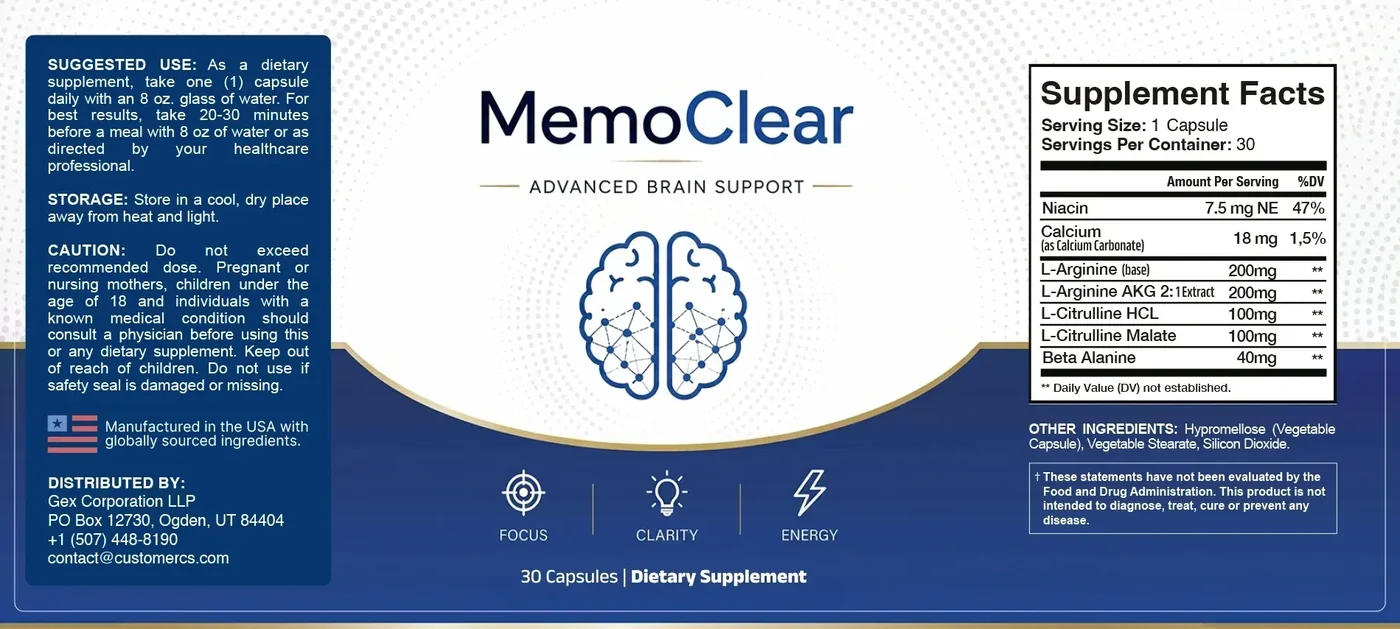
See a panel with nothing hidden in a blend
Memoclear lists each nootropic ingredient with its own amount — no proprietary blend, no guessing what is a headline dose and what is a token pinch. That is the minimum you should demand of anything you compare against Alpha Brain.
Check Memoclear Availability & OptionsWhat is the difference between Alpha Brain and Memoclear ingredients?
Strip away the branding and both products are built from the same broad toolkit the nootropic category has settled on: choline sources for acetylcholine support, adaptogenic and herbal extracts, an amino acid or two, and supporting vitamins. The difference is less about which ingredients appear and more about how much of each you can confirm, and on what timeline each one works.
Alpha Brain's blends lean on ingredients associated with acetylcholine and a calm-alert state — the sort that show up in short-term cognitive testing. Memoclear's disclosed panel is built around nutrients tied to blood flow, focus and everyday memory, each stated so you can see whether it reaches a researched amount. The practical takeaway is not "ingredient X beats ingredient Y". It is that with Memoclear you can verify the dose, and with a proprietary blend you are trusting that the useful ingredients were not crowded out by cheaper filler earlier in the list.
One more nuance worth its own paragraph: single studied ingredients versus multi-ingredient convenience is a genuine trade-off in its own right, and it applies to both products. We unpack the dilution problem — why a capsule can only hold so much, and what that does to a long ingredient list — in our piece on the all-in-one nootropic versus single-ingredient dosing question.
Caffeine, stimulants and how each one actually feels
A common assumption is that one of these must be the "stronger" stimulant. In fact both Alpha Brain and Memoclear are marketed as caffeine-free, which changes what "works" should even mean here. Neither is designed to give you a jolt you can feel within twenty minutes, so judging them on a caffeine-style kick is judging the wrong thing entirely.
That is actually a point in favour of both for a specific audience: people who want cognitive support without the sleep cost, the afternoon crash or the anxious edge that stimulants can bring. If you have been searching for a brain supplement that will not wreck your evening, the caffeine-free design of both products is a feature, not a shortcoming. The flip side is that you should not expect a dramatic same-day sensation from either — the honest expectation is a subtle, build-over-weeks effect, particularly for memory-oriented ingredients.
Alpha Brain asks you to trust a study. Memoclear asks you to read a label. The strongest buyers do both — and refuse to be sold on a feeling that neither product is designed to deliver.
Price per serving: what you actually pay
Sticker price is the wrong number. Price per serving is the honest one, and it is the comparison the packaging is designed to obscure. To calculate it, take the bottle price, divide by the number of servings in the bottle, and mind the serving size — a formula that looks generous can quietly assume two or three capsules per serving, which halves how long a bottle lasts.
Alpha Brain typically sells at a premium in line with its brand and its trial, landing around a dollar or more per two-capsule serving depending on where and how you buy it. Whether that premium is worth it depends entirely on how much you value that published study. For Memoclear, do exactly the same maths on the current options rather than trusting any number a review quotes, because pricing and bundle sizes change. The habit that protects you is the same for both: convert everything to cost per day, then decide.
Two more cost factors that reviews skip. First, a money-back guarantee changes the real risk of trying either one — check the window and whether it covers opened bottles. Second, bulk bundles almost always cut the per-serving price, which matters because memory-oriented ingredients need weeks of consistent use to be judged fairly. Buying a single bottle of a slow-building formula and quitting at week two is the most common way people waste money on either product.

Which nootropic is better for memory vs focus?
This is the question that should actually drive your choice, because "memory" and "focus" are not the same job and they do not run on the same clock. Same-day focus leans on faster-acting ingredients — a choline source such as citicoline, or the calm-alertness of L-theanine — that can shift attention within hours. Memory support, by contrast, tends to come from slow-builders that need eight to twelve weeks of daily use before a fair verdict is possible.
So the better product depends on what you are chasing. If you want a subtle lift in same-day concentration, weight your decision toward whichever formula puts a verifiable, properly dosed fast-acting ingredient on the label — which is exactly where a disclosed panel helps and a blend hurts. If you care about memory over a term or a project, evidence and consistency matter more than any first-week feeling, and Alpha Brain's finished-product trial is a genuine point in its favour. Many people, realistically, want both, which is the whole appeal of a combined formula in the first place.
Three objections worth answering honestly
"Alpha Brain has a study, so it must be better." A study is a real advantage, but a single manufacturer-funded trial in a modest sample is a starting point, not proof. Weigh it against the fact that you cannot verify Alpha Brain's individual doses, and against your own priorities.
"A disclosed label just means the doses are too low to hide." Sometimes disclosure does expose weak dosing — and that is the point. A transparent panel lets you catch an underdosed ingredient. A proprietary blend lets the underdosing hide. Transparency is only a downside for a product that has something to hide.
"I want the one that works fastest." Neither is caffeine, so neither is built for speed. If you need same-day alertness you are shopping in the wrong aisle; if you want durable support, patience and consistency beat any product switch.
Medical note: this article is general information, not medical advice, and neither product is intended to diagnose, treat, cure or prevent any disease. Speak to a healthcare professional before starting any supplement, especially if you are pregnant, nursing, taking medication, or have noticed a real change in your memory or concentration — that last one is a clinical question, not a shopping one.
Frequently asked questions
Is Memoclear better than Alpha Brain?
Neither is universally better; they win on different things. Alpha Brain has the stronger evidence, with a published randomized controlled trial on the finished product. Memoclear wins on transparency because it discloses every ingredient amount instead of hiding them inside a proprietary blend. If verified evidence matters most to you, Alpha Brain leads. If a readable label and knowing exactly what you take matters most, Memoclear leads.
Does Alpha Brain have clinical trial evidence?
Yes. Alpha Brain is one of the few consumer nootropics with a published randomized, double-blind, placebo-controlled trial on the finished product. The 2016 study in healthy adults reported improvements in verbal memory and processing speed at six weeks versus placebo. It was a single, industry-funded trial in a modest sample, so it is meaningful evidence but not the last word.
What is the difference between Alpha Brain and Memoclear ingredients?
Alpha Brain groups its ingredients into named proprietary blends, so you see the combined weight of each blend but not the amount of each individual ingredient. Memoclear lists each ingredient with its own milligram amount and does not use a proprietary blend, so you can check every dose against published research yourself.
Which nootropic is better for memory vs focus?
For memory, the ingredient with the most human evidence is the one you can verify at a studied amount, which favours a disclosed-dose label. For same-day focus, faster-acting ingredients like citicoline and L-theanine matter more. Because slow-building memory support and quick focus work on different timelines, the better choice depends on which effect you are actually chasing.
Scientific references
- Solomon T.M. et al. — A randomized, double-blind, placebo controlled, parallel group, efficacy study of alpha BRAIN administered orally (Human Psychopharmacology, 2016)
- NIH NCCIH — Dietary supplements and cognitive function, dementia, and Alzheimer’s disease: what the science says
- U.S. FDA — Dietary supplement labeling guide (proprietary blends and Supplement Facts)
- NIH Office of Dietary Supplements — Ingredient fact sheets for checking studied amounts
- Harvard Health Publishing — Twelve ways to keep your brain young
Related reading
Prefer a label you can actually audit?
One caffeine-free capsule a day, every ingredient printed with its own amount so you can run the same checks we did here — no proprietary blend to hide behind.
Still comparing the field? Start with our 2026 brain supplement buyer's guide.