Best All in One Nootropic Supplement vs Single Ingredients: The Dosing Trade-Off
Quick answer: is the best all in one nootropic supplement worth it?
An all-in-one is more convenient and usually cheaper per ingredient, but almost every one of them carries each ingredient below the amount used in research, because a capsule only holds so much powder. Single ingredients let you reach a studied dose and, more importantly, let you find out which one is actually doing something for you. The sensible split is to use a blend for daily nutritional coverage and a single ingredient when you are testing a specific effect.
- Blends win on: adherence, cost per ingredient, and covering minerals and B-vitamins you might be short of.
- Singles win on: reaching the dose used in trials, and isolating cause and effect.
- The tell: if the panel hides individual milligrams behind a "proprietary blend", you cannot check either.
What an all-in-one formula is really buying you
The pitch for a combined formula is simple and mostly true. One capsule is easier to remember than six bottles. A single purchase costs less than assembling the same ingredient list separately. And a good blend quietly covers nutritional bases most people do not check, which is where a fair share of real-world cognitive benefit comes from: nobody thinks better when they are short of B12 or magnesium.
Adherence deserves more credit than it gets. A supplement that gets taken four days a week produces roughly four sevenths of nothing if the underlying effect needs consistent daily intake. Trials that show a benefit almost always report high compliance, because that is what a trial protocol enforces. A blend that you actually take every morning can outperform a technically superior stack that sits in a drawer.
There is also a legitimate case for combinations on their own merits. Caffeine and L-theanine is the standard example, where the pair behaves differently from either alone. B-vitamins work as a group in one-carbon metabolism, so dosing them together makes biochemical sense. Electrolyte and mineral combinations are similarly conventional. Combination is not automatically dilution.
But those are combinations designed around a mechanism. Most of what is sold as the best all in one nootropic supplement is instead a list assembled for the back of the box, where every fashionable ingredient earns a mention and none earns a meaningful amount.
Best all in one nootropic supplement or singles? Start with the dilution problem
Here is the constraint nobody advertises. A size 0 vegetable capsule holds somewhere around 500 to 800 milligrams of powder depending on density. That is the entire budget. Everything on the panel, plus the flow agents and the capsule shell allowance, has to fit inside it.
Now line that up against the amounts used in human research. Creatine is studied at roughly three to five grams a day. Beta-alanine trials for muscle carnosine use several grams daily, split across doses. L-citrulline for blood-flow outcomes is typically studied in the region of three to six grams, and citrulline malate in exercise work often higher still. L-arginine studies for circulation land in a similar gram-scale range.
Grams. A capsule holds fractions of one gram in total. This is not a criticism of any particular brand; it is arithmetic. A single daily capsule containing eight ingredients physically cannot deliver a studied dose of any gram-scale ingredient, and any marketing that implies otherwise is relying on you not doing the multiplication.
The reasonable conclusion is not that blends are worthless. It is that a blend is a nutritional-support product, and it should be judged as one. The unreasonable conclusion, which the category encourages, is that a formula containing a famous ingredient inherits that ingredient's trial results.
Studied amounts versus what fits in a daily capsule
| Ingredient | Typical amount in human research | Realistic amount in a multi-ingredient capsule | What the gap means |
|---|---|---|---|
| Creatine monohydrate | About 3–5 g daily | A few hundred mg at most | Present as a label mention, not a studied dose |
| Beta-alanine | Several grams daily, split | Tens of mg | Far below exercise-trial amounts |
| L-citrulline | Roughly 3–6 g for blood flow | 100–500 mg | Nutritional support, not an acute dose |
| L-arginine | Gram-scale in circulation studies | 200–500 mg | Same gap as citrulline |
| L-theanine | Around 100–200 mg | 100–200 mg | Fits comfortably at the studied amount |
| Bacopa (standardised) | About 300 mg daily | 300 mg is achievable | Can be dosed properly if prioritised |
| Niacin, zinc, magnesium | Milligram scale | Full daily amounts fit | Blends handle micronutrients well |
Read that table twice and a pattern appears: milligram-scale ingredients are exactly what a combined capsule is good at, and gram-scale ingredients are exactly what it cannot do. That single distinction sorts most of the market.
See a panel that publishes every milligram
Memoclear lists each amount separately — no proprietary blend, no hidden split. That is the minimum standard worth applying to any product you are weighing up as a best daily nootropic supplement.
Check Availability & OptionsWhat single-ingredient dosing lets you learn
The stronger argument for singles is not potency. It is information.
If you take an eight-ingredient capsule and feel sharper three weeks later, you have learned almost nothing you can act on. You do not know whether it was the magnesium correcting a shortfall, the caffeine you did not realise was in there, the placebo effect of a new routine, or the fact that you started sleeping better because the bottle sat next to your bed and reminded you of your evening intentions. Next year, when the formula is reformulated, you have no idea what to look for.
Run one ingredient instead and the picture is legible. Pick the studied amount. Hold everything else constant, particularly sleep timing, caffeine intake and alcohol. Run it for at least four weeks for anything that works through nutritional status, or a single well-designed day for anything acute. Write down two or three specific, checkable measures beforehand rather than relying on a general sense of wellbeing, which is the least reliable instrument you own.
Then, and this is the step people skip, stop. A washout period is where the honest signal lives. If the effect was real and dose-dependent, its absence should be noticeable. If nothing changes when you stop, you have saved yourself a subscription.
This is a personal experiment, not a clinical trial, and it carries every bias a single-person unblinded test carries. You know what you are taking, expectation shapes perception, and one good week proves nothing. It is still dramatically more informative than adding a ninth ingredient to a blend and hoping.
A stack tells you whether you feel different. A single ingredient tells you why. Only one of those is a fact you can still use in six months.
When the blend genuinely wins
To be fair to the format, there are cases where an all-in-one is the better buy and the dose argument does not bite.
The first is micronutrient coverage. Vitamins and minerals are dosed in milligrams and micrograms, so a combined product can deliver full studied amounts of all of them at once. If your diet is uneven, this is the most reliable value in the entire category.
The second is cost and friction. Buying six separate ingredients means six shipping charges, six expiry dates and six chances to run out. For someone who wants steady baseline support rather than an experiment, that overhead is a real cost.
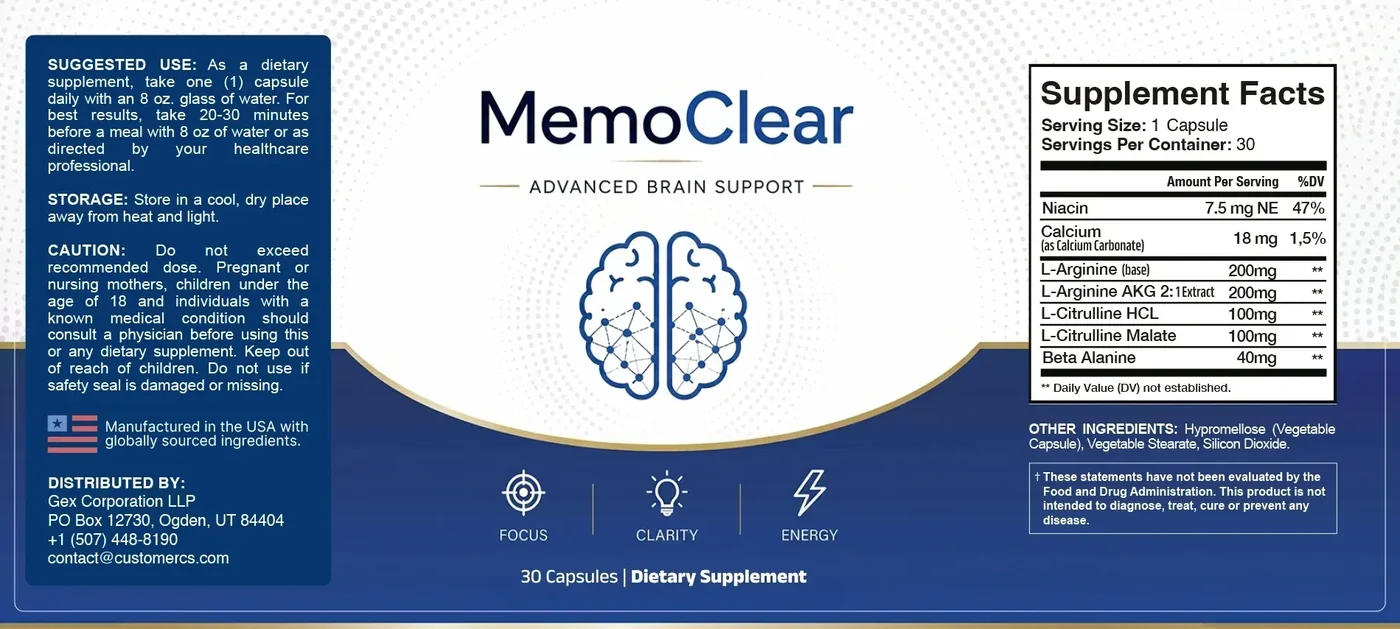
The third is when the blend is honest about what it is. A formula that publishes every milligram, positions itself as daily nutritional support rather than a clinical dose, and does not imply it inherits trial results, is a perfectly reasonable product. That is roughly the position Memoclear takes with its blood-flow amino acid panel: the citrulline and arginine amounts are stated in milligrams, well below the gram-scale amounts used in circulation research, and framed as daily support rather than an acute performance dose. Whether that suits you depends on what you want it to do.
The fourth is stimulant avoidance. A lot of people arrive here looking for a best brain supplement without caffeine, because the stimulant route costs them sleep. Blends built on nutrients rather than stimulants are a genuinely different product category, and comparing them on "kick" is comparing the wrong thing.

A five-minute audit for any formula
Whether you end up with a blend or a single, the same checklist sorts the field quickly.
One: are individual amounts disclosed? If the panel shows a combined blend weight instead of per-ingredient milligrams, stop there. Every dose claim about that product is unverifiable, and blends are ordered by weight, so the cheap ingredient is usually first.
Two: what is the serving size? A generous-looking panel often assumes three capsules. Divide by servings per container and check how long a bottle really lasts before comparing anything.
Three: which ingredients are gram-scale? Circle creatine, beta-alanine, citrulline and arginine. If any of them is the headline claim on a single small capsule, the claim and the panel disagree.
Four: which ingredients are dosed properly? L-theanine, standardised bacopa, and most vitamins and minerals can genuinely hit trial amounts in a capsule. A formula that gets those right is doing something real even if the amino acids are token.
Five: does the marketing borrow trial results? Phrases that attach a study to an ingredient rather than to the finished product are the standard sleight of hand. We unpack that vocabulary in detail in our guide to what brain booster labels actually mean.
What neither approach can do
Both formats share the same ceiling, and it is lower than the category admits.
No supplement in either column has been shown to treat, cure, prevent or reverse a disease, and none should be bought with that expectation. Support for normal function is the honest description, and even that is modest in size. If your memory or concentration has changed noticeably over recent months, that is a medical question and belongs with a clinician, not a shopping cart.
Neither format outperforms the unglamorous inputs either. Sleep duration and regularity, aerobic exercise, treated blood pressure, managed stress and a diet with enough protein and greens in it move cognitive performance more than any capsule on either side of this comparison. A supplement is a rounding error on top of those, not a substitute for them.
And self-experimentation has hard limits. You are unblinded, you are motivated, and a single person's four weeks cannot separate a small real effect from a good mood. Treat your own results as a reason to continue or stop, not as evidence about the ingredient in general. Anyone taking blood-pressure medication, blood thinners, or preparing for surgery should clear blood-flow ingredients with a clinician first, whichever format they come in. If what you actually want is the underlying ingredient evidence rather than the format argument, we set it out in what the human trial data show for nutrient nootropics, and the practical side of buying one — bundle pricing, shipping and the refund window — is covered in where to buy Memoclear and what the guarantee covers.
Medical note: this article is general information, not medical advice. Speak to a healthcare professional before starting any supplement, especially if you are pregnant, nursing, or taking medication — amino acids that affect blood flow can interact with prescription drugs.
Frequently asked questions
Is an all in one nootropic better than buying single ingredients?
It is more convenient and usually cheaper per ingredient, but each ingredient tends to sit below the amount used in research because a capsule holds a limited amount of powder. Single ingredients let you hit a studied dose and let you work out which one is doing something. Blends are better for consistency, singles are better for evidence.
Why do multi-ingredient formulas use smaller amounts of each ingredient?
Physical space. A standard capsule holds roughly 500 to 800 milligrams of powder in total. Ingredients studied at gram-scale amounts, such as creatine, beta-alanine and citrulline, cannot fit at their trial dose alongside anything else, so the formula carries a fraction of each.
How do I test whether one ingredient is doing anything for me?
Change one variable at a time. Take a single ingredient at the studied amount for at least four weeks, keep sleep and caffeine steady, and write down two or three specific measures such as afternoon focus or how often you lose your thread. Then stop for two weeks and see whether anything changes back.
Does a proprietary blend hide how much of each ingredient I get?
Yes. A proprietary blend discloses only the combined weight, so a headline ingredient can be present in a token amount while a cheap filler makes up most of the total. If a label will not tell you the individual milligrams, treat every dose claim about that product as unverified.
Scientific references
- NIH Office of Dietary Supplements — Dietary supplements for exercise and athletic performance (creatine, beta-alanine, arginine, citrulline doses)
- NIH NCCIH — Dietary supplements and cognitive function, dementia, and Alzheimer’s disease: what the science says
- Prokopidis K. et al. — Effects of creatine supplementation on memory in healthy individuals: a systematic review and meta-analysis of randomized controlled trials (Nutrition Reviews, 2023)
- NIH Office of Dietary Supplements — Magnesium fact sheet for health professionals
- Harvard Health Publishing — Twelve ways to keep your brain young
A blend that states every amount
One stimulant-free capsule a day, with each amino acid and vitamin listed separately so you can run the arithmetic above yourself. Useful if you are still working out where to buy brain supplements that publish a full panel.
Still deciding what deserves a place in the capsule? Start with which nootropics have replicated trial evidence.